
.jpg?width=3000&height=17&name=gold%20bar%20(thin).jpg "Gold Bar")

 By
By 
Everyone’s lost a key at some time or another. But when one of your organization’s keys goes missing, it can be more than an inconvenience. An unaccounted-for key could create security risks, operational disruptions, expensive rekeying costs, or compliance concerns. If you find yourself in that scenario, follow these seven steps:
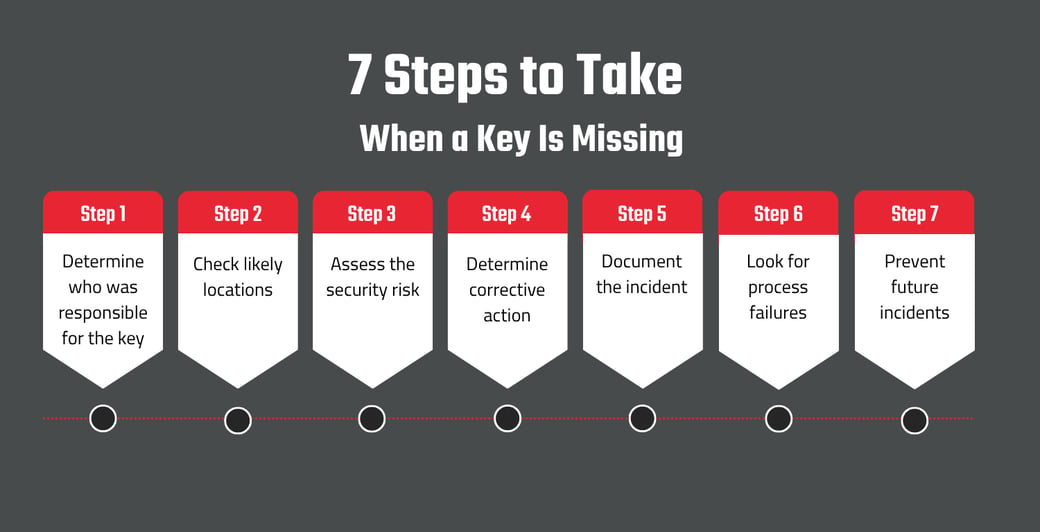
Step 1: Determine Who Was Responsible for the Key
Start by checking the key logs to see who last checked out the missing key (if that’s you, skip to step 2). If your organization doesn’t maintain key checkout records — or if it’s inaccurate or incomplete — ask around to see who had the key.
Once you’ve determined the person who last handled the key, contact them. If they no longer have it, ask if they shared it with another employee or a third party, such as a contractor, temporary employee, or visitor.
Step 2: Check Likely Locations
Before treating the situation as a confirmed key loss, verify that the key wasn't simply returned to the wrong location or misplaced during routine operations. Check areas where the person responsible was most likely to have misplaced the key, such as:
-
Desks
-
Incorrect cabinet slots or drawers
-
Supervisor or manager offices
-
Shared workspaces
-
Maintenance areas
-
Different departments
-
Vehicles
If you still can’t locate the key, treat it as lost or stolen and proceed with your investigation.
Step 3: Assess the Security Risk
Determine the key’s risk level based on:
-
The key’s access level (e.g., master key, grand master key)
-
What the key provides access to, including sensitive areas, valuable assets, vehicles, confidential spaces, or residential units
-
Any identifying information on the key, such as a location or asset name
-
Potential operational, financial, and compliance impacts, including downtime, rekeying costs, and regulatory penalties
-
Any connection to other suspicious activity, such as theft or burglary
-
Where the key was likely lost (e.g., a secure area or in a public location)
The timing and extent of the response should match the potential impact.
Step 4: Determine Corrective Action
Different risk levels require different corrective actions, including management escalation, rekeying, or temporary access restrictions. For example, a lost master key would require a different response than a missing storage closet key.
Be sure to follow your internal policy and consult the appropriate security, facilities, or management teams. Depending on your industry, location, and the circumstances of the incident, you may need to notify law enforcement, a regulatory agency, or another required authority.
Step 5: Document the Incident
Document the incident to help determine what went wrong, especially if there’s a criminal investigation or compliance audit. In your documentation, include:
-
The key type, along with any associated locations or assets
-
When the key was discovered missing
-
The last verified location
-
Checkout details, including date, time, responsible person, and reason
-
People, departments, or entities involved in the search or investigation
-
Summary of the search steps completed
-
Who was notified
-
Corrective actions taken
-
Costs incurred
A detailed record of the incident helps prevent guesswork if questions arise later.
Step 6: Look for Process Failures
When a key goes missing, it’s often a symptom of larger process issues. Common weak spots include:
-
Employees sharing keys without documenting the transfers
-
Unclear ownership
-
Incomplete manual records
-
Insecure storage
Correcting these process gaps helps your organization move from reacting to missing keys to preventing them.
📖 Related Reading
7 Reasons Your Key Control Process Isn't Working
5 of the Most Insecure Places to Store Your Business’s Keys
What Happens When You Don't Have Accurate Key Control Records?
Step 7: Prevent Future Incidents
To prevent future incidents, review your key control procedures and the tools to enforce them. Make sure your policy defines who oversees your key control program and who’s responsible for managing specific keys. Establish access levels, especially for high-risk keys, and regularly review user access, particularly when someone changes roles or leaves.
To ensure you can account for every key, maintain a clear audit trail documenting who removed a key, when, and why. Be sure to perform key audits regularly. An electronic key control system can automatically capture key checkout and return activity while enforcing user access levels, helping your organization consistently follow established procedures.
Finally, provide regular employee training to ensure they’re familiar with your key control policy. If a key does go missing, make sure they know what steps to take.
As soon as you realize a key is unaccounted for, acting quickly can help you either locate it or respond appropriately based on the risk level. Accurate records and a clear audit trail make that process faster and more reliable. By documenting the incident and correcting process gaps, you’ll reduce the chances of similar scenarios in the future. If a key is lost or stolen again, you’ll be able to respond promptly and confidently.
FAQs
What should I do immediately after discovering a key is missing?
Review your key records to determine who last had the key, check likely locations, assess the security risk, and follow your organization's procedures for lost or stolen keys.
Who should I tell if a key goes missing?
Notify the person or department responsible for key control as soon as you discover a key is missing. That may be a security, facilities, or management team. In some industries or situations, you may also need to report the incident to law enforcement, a regulatory agency, or another required authority. If you're unsure who is responsible, notify your manager immediately.
When is a missing key considered high risk?
A missing key is considered high risk when it involves a master key, access to sensitive or residential areas, potential compliance violations, or labels with identifying information.
Does a lost key always require rekeying?
No, a lost key doesn’t always require rekeying. The appropriate response depends on factors such as the key's access level, what it opens, where it was lost, whether it contains identifying information, and the potential security risk. Follow your organization's key control policies and consult the appropriate security, facilities, or management personnel to determine if rekeying is necessary.
How can organizations reduce the risk of lost keys?
Organizations can reduce the risk of lost keys by having a defined key control process, controlling access through a key control system, maintaining a verifiable audit trail, and regularly training employees on key control best practices.

