
.jpg?width=3000&height=17&name=gold%20bar%20(thin).jpg "Gold Bar")

 By
By 
Key management often isn’t a budget priority for business leaders — until something goes wrong. One seemingly minor oversight can quickly become a costly operational issue: A lost key incurs rekeying expenses. A security lapse exposes the organization to significant liability. A valuable asset goes missing.
If you’re considering an electronic key management system but worry about getting leadership buy-in, start with these six strategies.
1. Understand Leadership’s Concerns
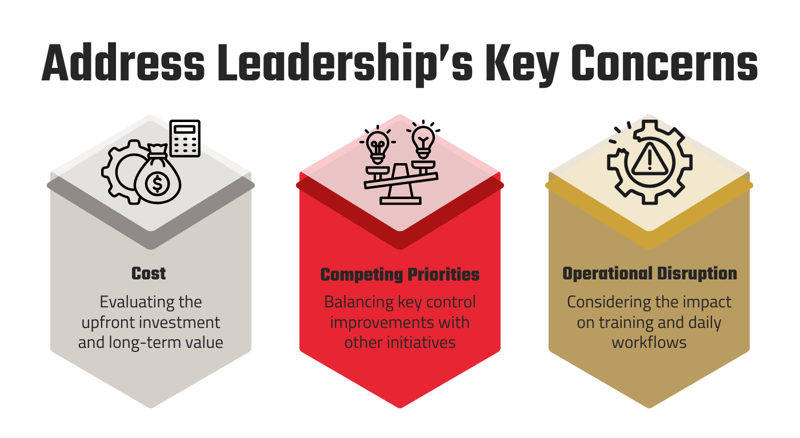
Before you propose a solution, learn the obstacles holding decision makers back and anticipate their objections. Common concerns include:
-
Cost: Even when solutions have clear long-term value, an upfront investment can cause hesitation.
-
Competing Priorities: Leaders might prioritize initiatives like cybersecurity or staffing.
-
Operational Disruption: Management may worry about training requirements or workflow interruptions.
Framing key control as a response to leadership's specific concerns, rather than a pitch for budget approval, makes the conversation more likely to succeed.
2. Demonstrate ROI and Cost Savings
Once you address leadership concerns, you can shift the conversation to outcomes. Instead of presenting electronic key control as a purchase, position it as continuous protection against preventable expenses.
Poor key management can lead to financial consequences such as:
-
Lawsuits from unauthorized access or security breaches
-
Fines or penalties for failed regulatory audits
-
Rekeying fees for lost or stolen keys
-
Lost productivity from manual key searches or manual logging errors
In addition to avoiding worst-case scenarios, electronic key control systems improve daily operations by reducing risk, saving time, and improving visibility into keys and assets.
When you present both measurable savings and operational benefits, the value becomes clear. Rather than viewing key control systems as an expense, leadership will see it as a strategic investment.
3. Highlight Security and Compliance Benefits
Physical security and regulatory compliance go hand in hand. Mechanical keys are one of the most common security blind spots, carrying risks such as:
-
Unauthorized access to sensitive areas
-
No audit trail to verify usage
-
Undetected duplication
Without oversight, these vulnerabilities can easily lead to expensive liability claims. In one case, a dealership employee caused an accident while driving one of the dealership’s vehicles on his lunch break. A jury ruled against the dealership — not because it authorized the trip, but because its key control process was loose enough to imply it had. The dealership was liable for $277,662.
Regulations and industry standards reinforce the need for key control. For example, Florida’s Miya’s Law and similar legislation in other states require documented key policies and accurate access records.
Standards like ISO 27001 call for controlled access to secure areas supported by verifiable audit trails. Even the strongest cybersecurity measures can be undermined when someone can walk into a server room unchecked. Cybersecurity and physical security must work together.
Failing to meet these requirements has real consequences: fines, failed audits, and legal exposure. Emphasize how establishing strong key control policies now is essential to avoiding violations in the future.
4. Emphasize Operational Efficiency
Electronic key control replaces inconsistent manual processes with accurate, streamlined workflows. Instead of relying on handwritten notes or informal handoffs, electronic key control systems can automatically authenticate users, track key activity, enforce access levels, and simplify return processes.
The operational impact of digitalizing key control processes becomes clear when comparing daily procedures:
Manual Key Management |
Electronic Key Management |
|
Accountability |
Responsibility gaps | Every transaction tied to a user |
Record Accuracy |
Incomplete or handwritten logs | Automatic, real-time records |
Staff Time |
Wasted time searching and logging | Streamlined checkouts and returns |
Key Visibility |
Little to no insight when keys go missing | Instant alerts for overdue or missing keys |
Reporting |
Manual, time-consuming process | On-demand reports |
These improvements reduce bottlenecks during busy periods and allow employees to focus on higher-value tasks instead of administrative work. When leadership sees how electronic key control supports every department, the value is undeniable.
5. Share Real-World Success
Real-life scenarios illustrate how valuable strong key control can be. Case studies and customer testimonials show measurable results in real environments:
-
A dealership group with a total inventory of around 4,000 vehicles struggled with frequently losing keys, leading to costly replacements and delays. After implementing key control systems, the group saw instant improvement in accountability, a significant drop in replacement expenses, and full visibility into key usage.
-
A multifamily community saves 30 minutes every time the maintenance team performs property-wide inspections. In addition, the system’s reports cleared the property of liability during a police investigation.
-
A higher education campus facilities director has used an electronic key control system for over 15 years to account for high-security keys and protect residents.
Common themes in these examples include:
-
Lower costs
-
Efficiency improvements
-
Stronger accountability and security
-
Audit readiness
Sharing these results builds credibility and shows the visible impact of electronic key control.
6. Address Implementation Concerns
Even when management sees the value, they might have concerns about operational disruption, training, and long-term flexibility. To address these concerns, set up a live demonstration with the service provider to show them exactly how the electronic key control system works. They can see for themselves how intuitive interfaces, role-based access, and simple training allow teams to quickly adapt without interrupting operations.
Emphasize scalability and flexibility, as well as ongoing support. Centralized oversight, customizable configurations, and consistent system configurations enable the system to grow with your organization. By addressing concerns upfront, you make adoption less intimidating and more strategic.
Reframing the Conversation
Key management may seem like a background function, but it affects your entire organization. When you show leadership how electronic key control improves visibility, reduces risk, and protects the bottom line, you turn it from a system expense into a smart investment they can stand behind.

